
The direction of the wood grain: What really matters in pallets, crates, and industrial packaging
Updated: Jan 6
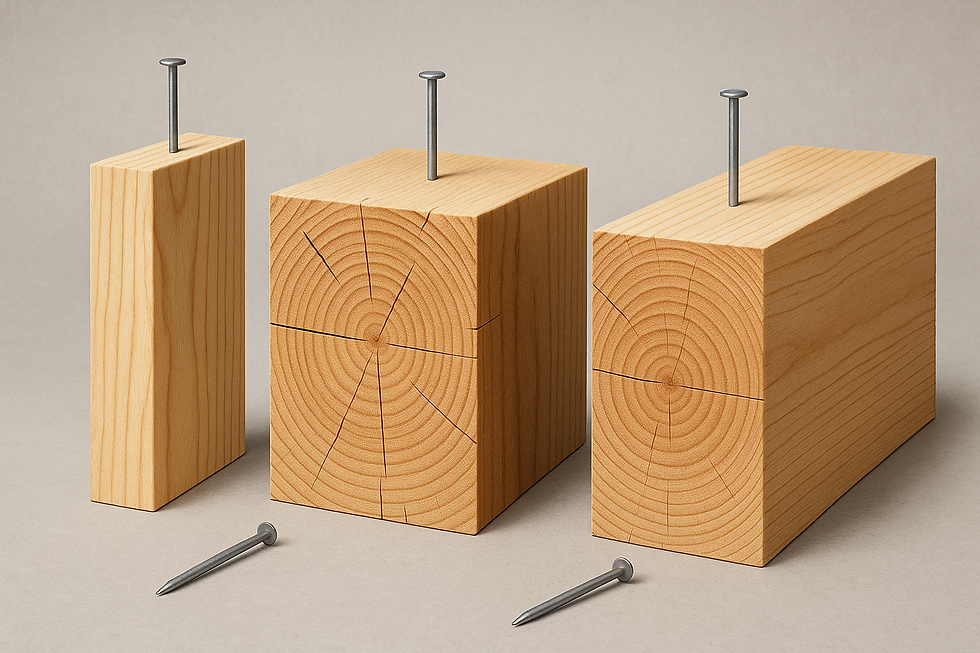
In the wood packaging industry, especially when designing wooden pallets, export crates, and server crates, there are multiple factors to consider; however, one of them can be "elusive" and difficult to verify once the component is assembled: the direction of the wood grain.
In the real world—where manufacturers don't control the original log cut and work with pre-dimensioned lumber (1x4, 2x4, 2x10, beams, etc.)—it's crucial to clarify which aspects of grain orientation can be controlled, which cannot, and how each factor influences the strength of the packaging.
This article explains, with a technical basis and a practical approach, how grain orientation, nailing, and strength parallel or perpendicular to the grain affect the performance of industrial packaging, such as packaging for servers and telecommunications equipment.
1. Influence of Log Origin and Piece Selection
In the wood packaging industry, component selection begins with understanding which part of the log the wood came from. This variable, though often overlooked, is the most significant determinant of the component's stability, strength, and performance within a pallet or crate.
When a manufacturer purchases lumber in standard sizes (1x4, 2x4, 2x6, joists, beams), what they are actually acquiring are different portions of the log, each with very different mechanical properties.
What does this mean for piece selection?
Larger pieces (such as joists or beams) typically come from deeper parts of the log, making them more stable and stronger.
Narrower boards (such as 1x4 or 1x6) tend to come from the periphery, where the grain is more curved and less stable.
Even within the same batch, two "identical" pieces can behave very differently depending on the part of the trunk they come from.
In short: the performance of packaging depends not only on the species, but also on which part of the trunk you're actually using for each component.
2. Beams, Planks, and the Influence of Log Origin
Even if two pieces have:
the same type of cut
the same commercial dimensions
and even the same species
Their mechanical behavior can vary greatly if they come from different parts of the log.
2.1 Heartwood
Straighter grain.
Higher density.
Less buckling and warping.
Better structural performance.
2.2 Sapwood
More curved grain.
Lower dimensional stability.
Greater shrinkage due to moisture.
More warping due to drying.
Therefore, beams and joists tend to exhibit more stable performance, not because they are inherently superior, but because they come from areas of the trunk with straighter grain and less variability. This stability is especially relevant when the packaging must withstand repetitive loads, vibration, or impacts.
However, this does not mean that simply “using beams or joists” guarantees good performance. In reality, the choice between a beam, joist, narrow board, or any other section should be made carefully, considering:
Which part of the trunk the piece comes from (heartwood vs. sapwood).
The grain orientation and straightness.
The structural function within the packaging (flexure, point support, impact resistance, frame stiffness).
The type of mechanical stress it will face (static, dynamic, vibration, lateral compression, etc.).
Thus, a purlin might be suitable for a support block, while a beam might be needed for long-span bending, and a narrow plank could work in non-structural components. Choosing correctly among these pieces—and understanding where they come from within the log—is essential to ensuring the best technical performance of the industrial packaging.
3. Side-Grain vs. End-Grain Strength in Wood Packaging
Wood is an anisotropic material: its properties change depending on the orientation of its fibers and how a load interacts with them.
3.1 Side-Grain Strength
When a load or nail acts in the same direction as the fibers, it is considered end-grain behavior; this means that:
Wood withstands compression well parallel to the grain, especially in thick pieces like joists or beams.
It offers very little resistance to nail pull-out because the fastener slides between the fibers.
Suitable for solid pieces where lateral separation is the main risk.
Typical applications:
Pallet blocks.
Thick joists.
Supports where the load is primarily vertical.
3.2 Side-Grain Strength
When the load or nail passes through the grain, we refer to it as side-grain strength.
Significantly higher tensile and shear strength.
Excellent nailing resistance—ideal for vibration.
Lower resistance to local crushing if the section is thin.
Typical applications:
Pallet skids.
Structural frames.
Components subjected to vibration (server crates).
3.3 Direct Relationship with Nailing Pattern
In packaging engineering, this is known as:
“Nailing perpendicular to the grain” ⇒ side-grain.
“Nailing along the grain” ⇒ end-grain.
Therefore, a board can be very strong “along its length” in terms of bending, but have poor nail pull-out performance if nailed along the end grain. The grain orientation defines how the wood behaves, and the nailing pattern defines how the fastener behaves.
Together, they determine the actual strength of the packaging.
4. Nailing: The Most Critical and Least Understood Point
The actual performance of a platform or crate depends not only on the wood but also on the nailing or screwing system.
Nails primarily work through friction and resistance to fiber tearing.
4.1 Nails Driven Perpendicular to the Grain
Better pull-out resistance.
Greater friction.
Lower probability of splitting.
4.2 Nails Driven Along the Grain
Much lower pull-out resistance.
Can create split lines (cracks).
Poorer vibration performance (server crates).
4.3 Real-World Consequences in a Server Crate
A crate may have high-quality wood… but if the nails are aligned with the grain, the crate can open with a lateral impact.
Therefore, an expert supplier must:
Choose the correct nailing orientation and position.
Ensure the best nail or screw selection based on the criticality of the area.
Apply nailing patterns that prevent crack propagation.
5. Nail Orientation Relative to the Grain: A Complete Technical Explanation
A critical aspect of the performance of a wooden pallet, wooden crate, or server rack is how fasteners (nails or screws) are driven in relation to the wood grain. To understand this correctly, we must first distinguish between two fundamental concepts of wood anatomy:
📌 Side Grain vs. End Grain: It Doesn't Depend on How You Rotate the Board
Side grain and end grain don't describe the physical orientation of the board in space, but rather how the nail penetrates the internal structure of the fibers.
Side grain = the nail penetrates fibers that run parallel to the side face of the piece.
End grain = the nail slides between fibers that terminate at the end face (the growth rings are visible).
Even if you rotate the board or turn the nail, what matters is the nail-to-grain relationship, not its orientation relative to the floor.
🔍 Illustrated Example
Case A: Fibers (rings) parallel to the floor, nail enters vertically:
Fibers →
→
→
Nail ↓
✔️ Here the nail penetrates the fibers → Side grain.
--------------------------------------------------------------------------------------------------------------
Case B: You rotate the board 90°, fibers become vertical:
Fibers ↓↓↓↓
Nail ↓
✔️ The nail enters parallel to the fibers → End grain.
--------------------------------------------------------------------------------------------------------------
Case C: Horizontal board, nail enters "lying down"
Fibers →
→
→
Nail →
✔️ Even though the nail is horizontal, it still enters parallel to the fibers → End grain.
This demonstrates that side grain and end grain do NOT depend on the board's orientation, but rather on the nail's direction relative to the grain.
5.1 Technical Comparison Between Side Grain and End Grain
Below is a table summarizing their differences:
Type of nailing | Nail-fiber ratio | Pull-out resistance | Vibration resistance | Risk of part separation | When to use it |
Side Grain | The nail pierces the fibers. | ⭐⭐⭐⭐⭐ High | ⭐⭐⭐⭐ High | Medium if the piece is thin | Critical zones, frames, server crates |
End Grain | The nail runs between the fibers | ⭐⭐ Low | ⭐ Low | ⭐⭐⭐⭐⭐ Very High | Large blocks, beams, thick pieces |
6. So, which orientation is best for your server crates and wooden pallets?
The best orientation depends on the purpose. There is no one-size-fits-all recommendation.
✔️ Use Side Grain when you need:
Maximum nail pull-out resistance.
Better vibration resistance (server crates, electronics).
Structures where the nail is used for shear.
✔️ Use End Grain when you want to:
Prevent large blocks from splitting due to lateral impacts.
Resist separation in solid pieces.
Utilize volume and density to absorb loads.
The key is that the supplier doesn't just "nail wood," but designs the pattern according to the type of load, the geometry of each component, and the expected behavior of the package.
Conclusion
The direction of the grain, the nailing pattern, and the ratio between parallel and perpendicular strength are factors invisible to the average user, but crucial for the safety of wooden packaging.
Although the manufacturer does not control the original log cut, they do control the board selection, structural placement, nailing pattern, and packaging design. These decisions make the difference between a reliable pallet or crate and one that fails under real-world conditions.
At Kayak Packaging, we design packaging considering not only the type of wood, but also how each piece behaves according to its grain, orientation, and specific application, guaranteeing superior performance in the export, handling, and transport of high-value equipment.
References
The following sources support the technical information presented in this article. All are verifiable and come from recognized organizations, peer-reviewed scientific literature, or official laboratories.
Forest Products Laboratory. (2010). Wood Handbook: Wood as an Engineering Material (General Technical Report FPL–GTR–190). U.S. Department of Agriculture, Forest Service. https://www.fpl.fs.usda.gov
Forest Products Laboratory. (2021). Wood Handbook: Wood as an Engineering Material (Latest revision available). US Department of Agriculture. https://www.fpl.fs.usda.gov
Forest Products Laboratory. (2018). Hardwood Log Grading and Lumber Yield. US Forest Service. https://www.fs.usda.gov
Bowyer, J. L., Shmulsky, R., & Haygreen, J. G. (2012). Forest Products and Wood Science: An Introduction (6th ed.). Wiley-Blackwell.
Green, D. W., Winandy, J. E., & Kretschmann, D. E. (1999). Mechanical Properties of Wood. In Wood Handbook. USDA Forest Service.
Western Wood Products Association (WWPA). (2022). Western Lumber Grading Rules. WWPA. https://www.wwpa.org
Canadian Wood Council. (2020). Species and Grades for Canadian Softwoods. CWC Publications. https://cwc.ca
FPInnovations. (2017). Canadian Wood Species Properties Database. FPInnovations. https://fpinnovations.ca
American Wood Council. (2017). National Design Specification (NDS) for Wood Construction. American Wood Council.
TimberQueensland. (2016). Strength Groups and Stress Grades – Australian and Imported Softwood Species. https://www.timberqueensland.com.au
National Institute of Standards and Technology (NIST). (2015). Wood as a Structural Material – Mechanical Behavior Summary. US Department of Commerce.
European Committee for Standardization (CEN). (2016). EN 338: Structural Timber – Strength Classes. Brussels: CEN.
Tsoumis, G. (1991). Science and Technology of Wood: Structure, Properties, Utilization. Van Nostrand Reinhold.
Forest Products Laboratory Chile (INFOR). (2019). Physical and mechanical properties of native and exotic woods from Chile. Forestry Institute, Government of Chile. https://www.infor.cl
Brazilian Forest Service / Embrapa. (2014). Amazon Madeiras: Characteristics and Use. Brazilian Agricultural Research Company.
American Society for Testing and Materials (ASTM). (2020). ASTM D143 – Standard Test Methods for Small Clear Specimens of Timber. ASTM International.
American Society for Testing and Materials (ASTM). (2019). ASTM D1761 – Standard Test Methods for Mechanical Fasteners in Wood. ASTM International.


Comments